
How Do You Handle Criticism When Your Writing Is Personal?
When you're sharing something that really matters, criticism can feel harsh—but it's still often valuable.

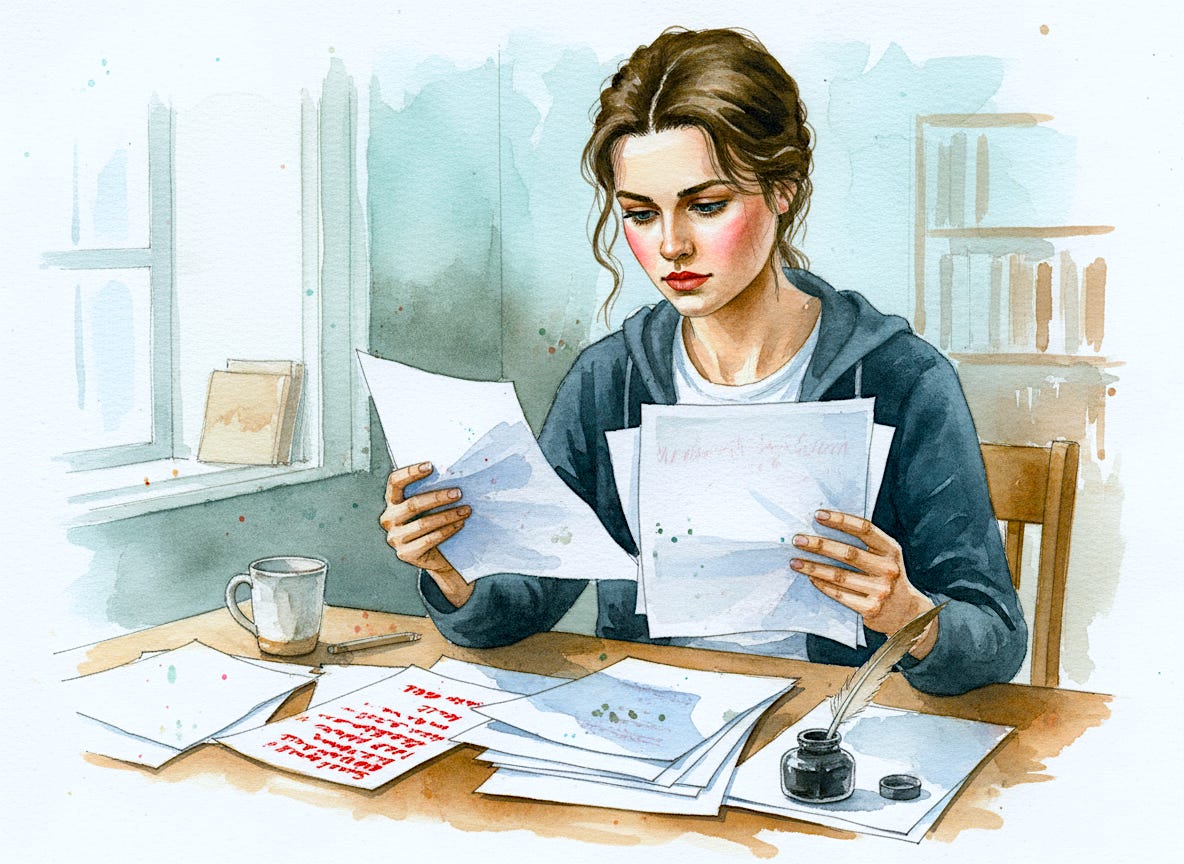
There I was, sitting in my professor’s office, staring at his desk as I listened to him talk about my short nonfiction story. It wasn’t bad by any means, but it felt very similar to something I’d written last semester. It needed direction and depth. He was polite about how he phrased things, and his feedback was necessary for me to become a better writer.
And I was devastated. I could hardly respond, tears burning behind my eyes. It wasn’t just the critique, to be fair. At the time, I was dealing with personal issues relating to my health, was scared and unsure about what the future would hold for me, and was overwhelmed by the state of the world. This was just the thing that happened to tip me over the edge.
The second I got out of his office, I went to the nearest bathroom, locked myself in a stall, and cried. If you’d asked me then, I probably couldn’t tell you what I was crying about exactly, but everything felt so heavy. After spending time with a friend and calming down, I emailed my professor and apologized for being so quiet and teary. I told him it had nothing to do with his response, and I appreciated his feedback. In an effort not to make me feel even more embarrassed, I believe, he didn’t respond. (Thank you, Jay!)
Thankfully, I now handle feedback much better. That’s not to say that I’m not still sensitive sometimes—I definitely am—but I know that the constructive criticism I receive from other mentors and peers is generally meant to be helpful and shouldn’t be taken personally.
I wanted to share some things that have helped me (and other authors I’ve worked with) handle constructive criticism and feedback.
Make sure you’re in the headspace to receive constructive criticism in the first place!
As you can probably tell from the above, I was not in a great headspace to be receiving constructive criticism at this time. The feedback itself was fair, but other factors really skewed my perspective of it. A few days later, though, I was able to be more objective as I reviewed it. Being in an academic setting, I couldn’t really push this off or delay this. However, outside of the classroom, we typically have a little more control over when we ask others to share feedback.
If you’re working around a deadline or you don’t have the option to control when you receive constructive criticism, try to build in some time to process everything, especially if you know that you’re sensitive to feedback. (Even if you’re not sensitive, it’s still helpful to give yourself a bit of a buffer and make sure you have time to thoroughly review everything; it’s easy to miss something on a first pass sometimes.)
Otherwise, though, if you have the choice, quickly check in with yourself before you read (or discuss) feedback. Reading feedback when you’re feeling defensive or upset isn’t ideal. Remind yourself that you don’t have to take every word as gospel, and the feedback is for your story, not for you as a person. Also know that you can grow as a result of constructive criticism. View the opportunity to receive any sort of constructive criticism as a chance to learn. If you’re having an off day and can do so, maybe wait until tomorrow to read that feedback.
It’s easy to take things personally when someone criticizes work that is intimate and meaningful to you. It’s helped me to assume that the reader, whoever they are, doesn’t have unkind intentions. They’re not telling me I’m a bad person or an awful writer if they suggest I change something or dislike a character or scene. Their opinion provides more information for me. As an editor, I’ve learned the importance of providing feedback from a place of respect and wanting the author to improve.
While it might seem a bit unnecessary, your emotions before you read constructive criticism have the ability to color your view of those suggestions and comments. Don’t be afraid to take inventory and give yourself time. When you do this, you’ll be able to look at constructive criticism clearly..
Keep in mind the context. Who is sharing the feedback, what is their perspective, and at what stage are you receiving feedback?